Friday, December 22, 2017

Dogland's Proposal to the U.N.


Not that the micronation of Dogland has yet been recognized by any substantial number of other nations, this quantum reality having only unfolded into existence about 26 hours ago, but anticipating the general approval of the world, here's our first proposal we would like the UN to consider.  And while we do consider this a crucial step in providing a safe world not only for our dog citizens, but also for the humans in our neighbor, America, we make no threats nor do we suggest any retaliation if the members of the UN need a few weeks to process this proposal--for clearly, a global civilization can't conduct its mission of bettering the lives of all involved in a hostile atmosphere.


Some background information first.  As of 2013, we passed 1 billion cars in the world.  And where?  "That gives China the world's second largest car population, with 78 million vehicles. But the United States still constitutes by far the largest vehicle population in the world, with 239.8 million cars," according to the Huffingtonpost, and there are predictions of more than 2 billion by 2035. 


 And is that a happy thing?  Getting a car is not only the dream of flocks of young teens, but of nearly everyone around the world, as that huge step up from the grinding limits of poverty.  We seem to believe in cars as that keystone of our independence, can't imagine life without cars--indeed, most of us seem pretty sure that all science and history talking about human life before Henry Ford is just scandalous propaganda.

Some consequences of all these cars...
land paved over"The United States, with its 214 million motor vehicles, has paved 6.3 million kilometers (3.9 million miles) of roads, enough to circle the Earth at the equator 157 times. In addition to roads, cars require parking space. Imagine a parking lot for 214 million cars and trucks. If that is too difficult, try visualizing a parking lot for 1,000 cars and then imagine what 214,000 of these would look like."
 

road deaths:   32,744 in 2014,  35,485 in 2015,  37,461 in 2016...and counting.  (There's a great chart there in Wikipedia.)

Even more danger to our citizen-dogs, and all the other critters who get squished on the road, 1000s of times a day.


And then, just the changes in who we are and how we live.  I assert that driving has never made anyone a better person, nor strengthened any neighborhood.

Perhaps most vital, the world just can't afford to keep this habit, neither in terms of production costs, resources used, nor carbon emissions.

 
                       source                                        image 


So, here it is.  We follow the notions of Ernest Callenbach, in his seminal, if not perfectly written novel, Ecotopia Emerging, in which the newly formed nation agreed to a list of key principles.  It's worth finding the book and looking at the 10 items on that "No more" list, but we'll adopt here, "No more private cars."  That's what we propose the UN vote on--finding ways to eliminate the automobile industry worldwide, before natural castrophies do it for us.


Talk to your dogs.  They'll agree.

later, 
President bob


Ernest Callenbach’s Last Wordshttps://learningfromdogs.com/tag/ecotopia-emerging/ 

Thursday, December 21, 2017

Instantiation

Here, a word the logic folks will quibble about:  instantiation:  "the existence of properties or universals is not tied to their actual existence now, but to their existence in space-time considered as a whole.Thus, any property which ishas been, or will be instantiated exists."

In any case, I set my alarm, waited till 10:28 am today, and suddenly, in the whirlwind of what is, Dogland popped into existence.

Turns out though that it's hard to photograph both a moment of quantum coherence, which often looks pretty much like the moment before (the problem of continuation still much to be argued in one object theory or another), and the moment of the winter solstice.  For the solstice--would I be photographing the earth's brief new tilt?


Or something about the seasonality?  Today, when one bank I drove past asserted that before noon, the temperature was 65 degrees F, while the one up the hill said 56.  In either case, much is still green, too green for December 21.             


And I scooped a very lively tick off one of the dogs after our morning walk along the edges of our new nation.  Alas.  Much is out of order. (Note the current and continuing rise of CO2, as charted by the still not-suppressed NOAA--just now over 406 ppm, vs. the pre-Industrial baseline of 285, or worse...).
    

later, bob

Wednesday, December 20, 2017

Dogland Visa


                     DOGLAND VISA

Valid for one visit, not to exceed 12 hours  


Full legal name__________________________________      Date___________________
Three major aliases ______________________, ______________________, ______________________
Nationality      _________________________________________
Purpose of trip (attach additional pages if needed)_______________________________________
Have you visited any hostile national entities in the last three days?         Yes        No
Have you eaten any forbidden fruits this year?                                          Yes        No
Do you own one or more cats?                                                                   Yes        No
Have you ever been injured by a cat?                                                         Yes        No
Do you have permission from your dogs to enter Dogland?                      Yes        No
Will your dogs be escorting you?                                                                Yes        No
Do you support the eradication of autumn olive?                                       Yes        No
Do you own, or have you had any intimate physical contact
with, any of these in the last 3 weeks (circle any that apply): 
Llamas, reindeer, polar bears, mudpuppies, black rhinos,
Neanderthals, puffins, golden toads, Irish elk, quagga,
or ivory-billed woodpeckers?                                                                     Yes        No

Do you support the International Convention
for the Regulation of Whaling?                                                                   Yes        No

Have you seen any meteors in the last 10 days?                                        Yes        No

Have you seen Star Wars:  The Last Jedi?                                                 Yes        No


Applicant’s signature ______________________          Approved,  DL Secy. of State 


Tuesday, December 19, 2017

Dogland


As of Thursday, December 21, 2017 at 10:28 am CST , owing to the constant and irrepressible eruption of the quantum ground, out of which we all constantly bubble, we declare the existence of the micronation of Dogland.  We predict this outburst of sovereignty will exist for one week. 


The borders of this new nation are derived from the dog-driven dérive, which enfold our actual homeplace/property, but extend farther and furtively along dark roads and back fields.  


Our nation slogan:  Trespass      

Founders and First Citizens, Hector, Cybele, and Dorothy


President, Robert Boon
Vice President, Mike Schatz
Secretary of State, Ashton Schatz
Secretary of Defense, Tim McGovney
Secretary of the Interior, Soren Larsen
Secretary of Health, Education and Welfare, Mike O'Conner 
Director, National Endowment for the Arts/Science Advisor Jim Evans
Surgeon General, Graham Greer        
Attorney General, Hao Nguyen 
Postmaster General/Special Counsel to the Founders , Murphy Boon Schatz
Evie McGovney, Secretary of Energy
Alice McGovney, Director of Homeland Security
Mike Urban, Director, Dogland Army Corps of Engineers
Mark Palmer, National Quantum Cartographer
Matt Jacobson, National Wildlife Director

Our national beverages:  coffee from Lakota, Pinot Noir from Oregon, Busch Lite at D&D Pub, and Guinness anywhere
Our national anthem:  Ol' Red [video by honorary citizen, Blake Shelton]

Information about Citizenship and One-day Visas forthcoming.


Place-Making


I've not been much interested in some of the standard ways we track place [and we could insert here whole volumes of crusty material, or more interesting histories, like Edward Casey's The Fate of Place], certainly not in place as yet one more quadrant of "the grid."  And I can't simply say 'place is the subjective version of objective real space,' because that falsifies reality, shifts us merely to the barren ground of the long, harsh ontology of the modern West.  None of that.

More, that place itself an unstable phenomenon, an occurrence and continual re-occurrence, that involves not only the physical items in our view, nor merely the elements of power, nor just the various plants and animals and rocks and other folks.  But all of those together.  I think I'll borrow from one of my own documents in progress, some book of poetry, some interminable thesis-thing:


I’ve wanted to test out how place-experience ‘informs’ new place, but that isn’t strong enough, suggests too much graceful observation as we glide along in our hover cars.  Not ‘sensibility,’ not memory exactly, but what is crucially involved in place-making—that is, how we use our experience, all of it, to actively and actually shape the places we tread, at every moment.  The and actually is important.  I’m not a believer in a reality that waits for us to draw grids across it, nor a reality that is independent of our observation.  Nor one that we control.  Not magic, and not stability.
That is, place-making itself is the “apparatus” that we are constantly involved in.  (I steal liberally from Karen Barad’s Meeting the Universe Halfway: Quantum Physics and the Entanglement of Matter and Meaning, whose title I already appropriate and misshape.)  That is, there is no solid ground beneath us, or around us, or ahead or behind us.  With each little shimmer of the universe, we participate in creating place.  No, we aren’t wizards, conjuring up that bit of land we need in the middle of a stormy sea, nor can we whip up a pocket universe to save us from the ravages of demonic invasion.  Not exactly.  We don’t have such power.  But we do participate in that process, along with all the other agents that share this universe with us—so that all our experience, knowledge, biochemistry, fleshy history, even our imagination, these all shape that process, ever so slightly, at every moment.  Nothing detached, nothing innocent.  Ecology and ethics in every breath, every step.
Perhaps I can say this efficiently:  we live in a universe that is very real—not illusion, not human construct or category—a universe which simply isn’t solid or fixed.  Not even time or space exists in any stable form, nor any part ever in isolation.  This invites us to re-imagine who and what we are, in terms of biology and geology.  Quantum physics is certainly in the background, in my naive understanding of it, but I want mostly to work at the scale of human/other bodies and our collective place-making.  This, against the background of the Anthropocene, the grand catastrophe we in these generations will not outlive.
Do investigate Karen Barad--a nice look at "apparatus" here, or a useful interview.


***

All of this a long way to get to the essential problem--I haven't stayed in the U.S. for Christmas yet this century, avoiding this most gruesome holiday at all costs, whether it's wandering the old city of Taipei or trudging through the slush in Quebec City, or, or.....


But this year, with my expensive new eyes (ah, some gruesome moments there), I can't/shouldn't afford to travel.  So if I can't afford to leave this country in the traditional way, planes, trains, automobiles, Korean sub, hot air balloon, and there's no "Beam me up" option, well...

Not that Hallsville isn't swell, but...  


Next post.

later, bob

Micronations


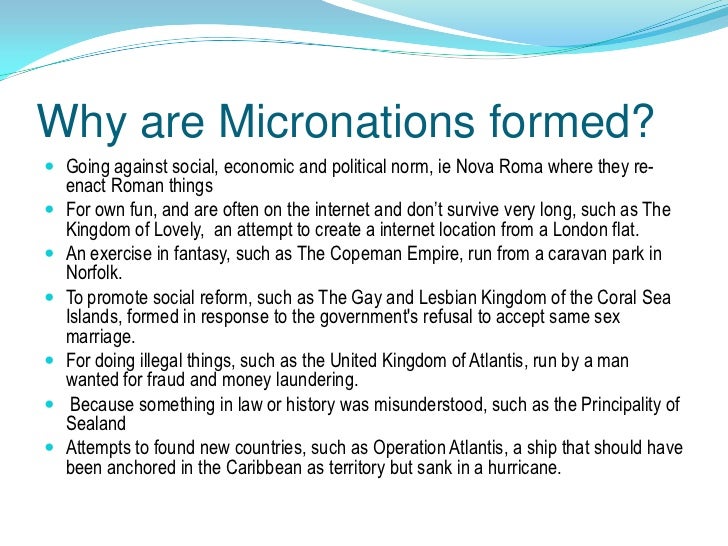
Here's a bit of alternate geography, these self-proclaimed countries called micronations.  As our friends at Wikipedia tell us (and have you donated to Wikipedia yet this year?  I have):
micronation, sometimes referred to as a model country or new country project, is an entity that claims to be an independent nation or state but is not recognized by world governments or major international organizations.
Micronations are distinguished from imaginary countries and from other kinds of social groups (such as eco-villagescampusestribesclanssects, and residential community associations) by expressing a formal and persistent, even if unrecognized, claim of sovereignty over some physical territory. Micronations are also distinct from true secessionist movements; micronations' activities are almost always trivial enough to be ignored rather than challenged by the established nations whose territory they claim.
          Find that here.  
Lots useful here--the distinction from secessionist movements, which get everyone bent out of shape, and the notion that such sovereignty involves a claim over physical territory.  Ah, such...last century thinking.
Here's a visual for where they've popped up:


Business Insider points at what they claim are the "most interesting micronations".  North Dumpling Island does sound intriguing:  "Summer home of Dean Kamen, the man who invented the Segway, North Dumpling Island is a small piece of land off the coast of Connecticut. Kamen, or “Lord Dumpling” as he likes to refer to himself, even got then-president George H. W. Bush to sign a “non-aggression” pact with the nation of North Dumpling. The island is powered by a wind turbine, solar panels, a helipad, and a replica of Stonehenge."
And of course, there's a web page on how-to-do-it-yourself, which I'm going to ignore...


I rather like the micronation of Sealand, and am contemplating becoming a Lord or Baron for 44.99$.  I'd go for the coffee mug, but I'm guessing the shipping rates aren't friendly.
And why all this obscure interest in micronations?  Besides having just turned in my very last set of grades for this semester?  More to come...
later, bob


Tuesday, September 29, 2015

Putting Things in My Mouth

Here's my new enthusiasm...the berries on this odd shrub.


Here's the tale: these grow out in my field, here and there, in that way that says that seeds were scattered by birds. My neighbors just to the west had deliberately planted a whole row of them along their fence, as a privacy screen from the road, and I wouldn't doubt that those were a local source. (And though I've never seen a plant over 8 foot tall, Boone Electric insisted on destroying that whole row of nice shrubs, to protect, um, what? The electric lines high above that these shrubs would never reach?)


In any case, I've been trying to i.d. them for quite a while. My usual Geography wizards failed. (Our resident biogeography expert went back to 'I don't do shrubs.' Sigh.)

From the leaf color, that silvery underside, I started looking at Russian Olive.  The trees do look a lot like those fields of olives you see on the hillsides of Greece and Cyprus.  But the descriptions of the fruit just didn't match.


Forager's Harvest tells us that    
Fertilized flowers produce olive-shaped fruits that are typically a little smaller than a currant or pea. Unripe clusters of autumnberries hang all summer long with little change, remaining light, dull green. In fall they plump up and turn to a bright orange-red but remain coated with silvery flakes. Each ripe autumnberry contains one seed, and these are very distinct in appearance. Soft-shelled and constricted to a point on each end, the yellowish-tan seeds have prominent lines running their length.

Hmm...

Long hiatus. From some accidental weblink, I looked at Autumn Olive. And there in my fields, where I walk the dogs every morning and afternoon, easily a hundred gallons of fruit. Still, I hesitated, envisioning a CIS episode, featuring my bloating, purple-blue-green body writhing with local carrion fly maggots, my dogs whimpering in the background, being restrained by Animal Control, until that sudden camera focus for the jaded, pithy comment, and then cut to commercial. So, see, I exercise proper caution...


http://i.dailymail.co.uk/i/pix/2010/02/04/article-0-003F1C8600000258-646_233x292.jpg 

But then at the D & D Pub, I was talking to Becky as redneck karaoke revved up, and she said something about her several specialties, which include Master Gardener (a program I need to jump into!), and after I described this strange fruit, she said, sure, that's Autumn Olive. I finished a few more cans of Busch Light, and considered.
    
[Notice that the mountains are still there--"Same Classic Taste"--but "Special Edition."  Critters and trees on our mountains now!]

Then one afternoon last week, the temperature up there again in the high-80s-swelter range, I'm in the field with dogs, no shirt, no rush, and I remember to google, and yep, this Forager website convinces me I've got the right thing, and that it won't kill me, so I just start eat the alleged Autumn Berries. Ever prudent, I did email Matt and Soren: Subject line: "Those red berries."  Message, "I've decided those are autumn olive and that I should try some. I just did..."

I guess I neglected to mention to them that I was out in the field alone, except for dogs who probably wouldn't do the 911 thing, and if I fell over twitching, would not be visible from the road. Oops.  I wasn't a Boy Scout.

But everything was fine, no toxic kick, and the berries are delicious.


There are some issues.  Here's the official hostility:

From Nature.org, we get this history of this dire invader: 

The autumn olive is a native plant of China, Japan and Korea that made its way to the United States in 1830. In the 1950s it was widely promoted as a great way to provide wildlife habitat and erosion control in environmentally disturbed areas.Although it did make available habitat and food for wildlife, it soon became a major problem as autumn olive began to rapidly spread throughout the state. To make matters worse, attempts to remove the shrub by cutting and/or burning created even more autumn olive.
They continue: 
Autumn olive is an invasive species that out-competes and displaces native plants by creating a dense shade that hinders the growth of plants that need lots of sun. It can produce up to 200,000 seeds each year, and can spread over a variety of habitats as its nitrogen-fixing root nodules allows the plant to grow in even the most unfavorable soils. Not to mention that it reproduces quickly and with little effort at all.   Birds are quite attracted to the seeds, and will scatter them throughout pastures, along roadsides and near fences. Even attempting to remove autumn olive by cutting or burning from your property can cause unwanted spreading as the shrub germinates easily.
From the Missouri Department of Conservation, a group I tend to trust over everyone else, at least for identification, we hear that the Autumn Olive is
Invasive. It was studied in the 1940s by the Soil Conservation Service, and the strain 'Cardinal' was released in 1963 for commercial propagation. In the eastern and central United States, autumn olive was planted to provide food and cover for wildlife, as screens, windbreaks and barriers along highways, to stabilize and revegetate road banks, and to reclaim mine spoil. For some years after planting the plant seems contained, but then it suddenly becomes invasive and difficult to control.
And nice info about its life cycle: 

Plants flower and develop fruits annually after reaching 3 years of age, although 2-year-old plants have been known to flower. A single plant can produce up to 8 pounds of fruit. Seed dispersal appears to be mainly by falling fruit and by birds. Birds seem to be the primary vector for dispersal, although raccoons, skunks and opossums are also known to eat the fruit. This species is highly invasive and difficult to control. Burned, mowed or cut plants will resprout vigorously.
The MoDOC conclusion, the "Autumn olive’s invasive nature far outweighs any useful qualities, and its cultivation is strongly discouraged."  Well, I might not go with them there.
They do tell us that "this non-leguminous, nitrogen-fixing woody shrub can adversely affect the nitrogen cycle of the native communities that depend on infertile soils. These characteristics make it an aggressive and competitive threat to native species in open communities such as prairies, savannas and woodlands." Huh. Something that fixes nitrogen in poor soils.  


Forager's Harvest adds this:  
Autumnberry is one of the few non-leguminous plants able, with the help of certain bacteria called Frankia, to fix Nitrogen. This allows it to thrive on impoverished or eroded soils and outcompete other shrubs on such sites. It is precisely for this reason that it was used widely to reclaim and stabilize old mine spoils, eroded hillsides, and newly constructed roadways. Such soil-deprived sites are where it remains most common today, accounting for its abundance in steep, hilly country that has been inappropriately cultivated or overgrazed, and in rocky, sandy, or gravelly areas where the soil is naturally poor.
[Ok, here's one of my naive flights-of-fancy.  Have been reading Gaia Vince's Adventures in the Anthropocene for a class, and just today, hit Chapter 4, with its history of artificial fertilizers, that way that we use soluble ammonia to keep those fields going.  So much so, that Vince claims that "Half of the protein in our bodies now comes from ammonia made in the Haber-Bosch process.  Billions of people owe their daily bread, rice and potatoes to artificial fertilizers" (108).  That, of course, is the jolly side of the Green Revolution, and its successive shades

Rethinking development in the 21st century - Vandana Shiva at the Governance Innovation Week 2014   

Here, I have to let that science-fiction-trained-mind drift ahead, into some Anthropocene not-quite-apocalypse, and wonder when and where we might need alternate strategies for every part of our food cycle. Alternate, as in, fertilizers that don't overwhelm the fields and kill the oceans.  Wish I had access to some Forestry/biochem genius, who could whip out calculations on whether we could rehab overused fields with however many years of Autumn Olive.  10 years?  15?  How many fields in rotation would make this useful?  Would Autumn Olive and their microbial buddies make enough difference to exhausted soil?  Could we find could uses for the shrub-wood when those were cleared?]

Meanwhile, Forager's Harvest adds that "Autumnberry may be found in southern Canada and all but the driest parts of the United States. In some regions it is rampantly abundant, and I will dare to say that this is the most common edible wild fruit in the eastern United States." And that, 


Upon first turning red, the flavor of autumnberries reminds me of raspberries or pomegranates with the pucker of chokecherries. As they ripen the puckering quality fades, the fruit sweetens, and a hint of tomato flavor develops. I love to eat fully ripe autumnberries straight from the bush. I stuff my face with one handful after another for the first twenty minutes of picking. The seedshells are soft and contain a delicious nutty kernel that seems to disappear in your mouth as you chew. Some people swallow everything, but I spit out the masticated seedshells when I am done absorbing all the flavor possible, then reach for another handful.

Beyond this spit or swallow advice, another source, Wildcrafting, states that "The berries also contain high levels of vitamins A, C and E, and flavonoids and essential fatty acids." More nutrition info here...which stresses the high levels of lycopene, and here's some folks who want us to make some wine out of my happy handful of red berries.


Here's the not-conservation conclusions:

Wildcrafting:  "There is great value in many of the wild (and escaped) plants around us. If we rely on marketers to point out what is of value, we’ll miss much of the natural world and its intrinsic benefits. Here is a plant that is both a treasure and a bane. Certainly a partial solution is to eat as many berries as possible, don’t replant it, and let it help you to be healthier."

And Forager guy: "If our continent is going to be overrun by exotic invasive plants, I pray that there are more of them like autumnberry."

I'll eat to that.


later, bob