Sunday, July 12, 2015

Time Capsule


February 11

     When I scribbled a note or two to think about this post, I titled it, "Just Plants," because all I really wanted to do was show some pictures of plants that bookmark the passing year.  And I certainly wanted to dodge the scorn and snorts of actual biologists, since I'm not trying to identify anything, nor study any process.  Biologists: Real Science.  Equally I need to dodge the derision of the biogeographers, who would study location, distribution, other processes, and would have nifty, interactive GIS displays faster than I'll be able to type this out.

     However, "Just Plants" gave way to the bigger claims of "Time Capsule."  Here's why.  2 reasons.  The first--although this isn't science, neither rocket-, genetic-, nor atomic-, let's put this in the context of our shifting, ever-more-chaotic climate.  That is, not just that the weather is weird, but that weather, patterns of rainfall, episodes of cold and drought, what the birds do, which insects thrive or don't, which flowers they visit, and how all those line up with everything on the ground, especially our not-so-mobile weed and tree neighbors, really matters.  The weeds, and some of the trees, are pretty resilient--robust, dynamic, whichever jargon you want to be in--but not infinitely so.  A lot of them will likely survive the collapse (that is, the chaotic rearrangement of the climate systems we grew up with, this last 10,000 years), a far off collapse, about 15 or 20 years, I'd guess.  However,we aren't likely to understand the landscape that comes out the other side of this intense change.

     And more not-good-news, human agriculture is way more fragile than these "natural" systems.  Oh, you've heard the recent concerns in Missouri about getting the soybeans planted, or getting the first haying done, or crops washed out by too much rain.  And we might worry whether our later summer will stay wet enough, or suddenly shrivel into a long dry stretch like last year, or the grim 2012.  A long totally dry summer is only swell if you think your Saturday BBQ has nothing to do with what happens on the farm

     Sure, maybe we'll develop some drone technology, happy little mechanical dragonflies set to hover over the fields and spit seeds into the ground, or maybe we'll come up with some down-home version of Star Wars Imperial Walkers to wade through the mud, planting soybeans and shooting down the Jetsons' hovercars that are bothering the cattle in the north 40. That's the technophile, modernist scenario for how the Anthropocene turns out--this new geologic age in which the planet and all its systems are human-influenced.  Machines to fix all our problems, with no changes in how we think or act?  Cool science fiction, if you're rich enough to play those games.  Most of the world isn't, and that's a problem, if we want reliable food, and plenty of it.

     Here's an article worth looking at:  "Opinion: Stephen Hawking's catastrophic end for Planet Earth."  Lots of advice for us humans, but let's focus on a passage from Mark Cackler, "the World Bank’s manager for global agricultural and food security." He tells us that:
The human race is “trapped in a vicious circle” according to the World Bank’s agriculture manager, “we will need to grow 50% more food by 2050 to feed 9 billion people … but agriculture, which is paradoxically vulnerable to climate change, generates 25% of heat-trapping greenhouse gas emissions that lead to climate change.”
This is essentially a no-win scenario, a zen koan, the ultimate question that has no real answer: The more food “we grow using conventional methods, the more we exacerbate the problem. It’s time for a climate-smart agriculture. But first we must address a few manmade problems.”  
Hawking, meanwhile, is urging us to hurry up and get off Earth.  I don't disagree, and I liked Interstellar, despite that actor who can only talk Texan.  In that film, humanity at the last possible moment, our crops collapsing, our atmosphere shifting, manages to reach the stars, and somehow afford to transport enough folks to new worlds. (Do read Kim Stanley Robinson's Mars Trilogy sometime, for amazing insights into arguments about our expansion, terra-forming, who survives and who doesn't, respect for the place itself vs. pressing human need...With trepidation, I'll also report that it may become a TV series.  But read the books first!)

     Yes, survive, explore, learn.  But not abandon.  I'm not ready to give up on Earth, much as I'm eager to soar off to Mars, as long as I can come back for my dogs.  Even less am I ready to take the same wrong thinking with us, the thinking that put us on a bad path. Hmm...am I (and my captive students) the only ones who make it to the end of A Canticle for Leibowitz? I'm left almost thinking that we need enough human collapse, just enough hard slap in the face, to recognize that all this is already underway.  That we need to see what's going on before we destroy the very ground that future humans will need to build a better civilization. But wishing for collapse puts us on a much darker trail...

     Better, Aidan Davidson, in an article Soren is having me read, "Beyond the Mirrored Horizon: Modern Ontology and Amodern Possibilities in the Anthropocene," in Geographical Research, 2015.  There, Davidson talks about different paths for the Anthropocene, one being 
washing away modern hubris, opening up realms of choice within planetary dynamics that are inherently human but not reducible to human agency. This is to accept that the mysteries of geology and biology and the mysteries of politics and culture fully inhabit each other (2).  
I much like Davidson's description of global warming as our "ongoing industrial accident" (6), and "amodern" is a great term. A lot more to explore here, seeing our place-time in frameworks like that.


  * * *

     So, just some plant pictures.  These don't claim to be anymore than a bit of memory, a way to say, "back in 2015, this month and day, in Boone County, these plants, and occasional critters, amidst a whole lot more, were alive."

April 27:


May 9
 
(yes, these are the despised bush honeysuckle)

May 12: 


May 14:


June 6:


June 7:
 

June 9:
 

June 11:

June 14:
 

June 16:
 

June 17:


June 18:


June 19:


June 20:

June 22:
June 26:

June 28:


July 1:


July 2:


July 6:
 

     Back at the start, I said "2 reasons."  Here's the second, something "easy" for us to deal with, right here, right in our very own ditch, our own cranky drive to work: relearn what is beautiful.  That is, there is a beauty we don't control, beauty we don't plan.  Beauty that is part of us, but beautiful because it exists with its own agency, its own life, however much enfolded with ours.

     Just that.  And everything starts to change.

later, bob


July 3


Friday, July 10, 2015

And now the Rose...


I snapped this photo on the way toward the First Friday event, and thought not much about it.  I remember the long-ago establishment here, which gave way to Mojo's, which I'd never liked, so I pretty much have ignored the new incarnation of this little music space down there in what used to be the industrial backwater, our own sketchy patch of downtown Detroit, before the Arts people here decided to upscale the whole neighborhood.  Now, it's the Rose Music Hall


But I'd had that sip of beer at the Orr Street Studios, and it was a sunny Friday, a rarity in this long wet season of Washington in the Midwest.  And there was a balloon over there in that bland sky, balloons always a joy (I regret that Columbia hasn't snagged that balloon competition again--we had a good 3-year run of balloons-galore back in the late 90s; I still have one tattered t-shirt from that, and an X-rated story I won't tell), so I decided I'd at least try this new Rose, all the while eager to be confirmed with the worst.

     I walked up to the gate, sure there'd be a cover charge, an automatic/righteous No way! (like the next day at Quinton's) that would let me get on with my business, walking the dogs, starting up the skin-alert for ticks, picking out a new movie to maintain my high culture status.  But no!  No cover.  No one even noticed me walking in.

     At the bar, inside the big music hall room, they still have all those taps.  I picked out what I think the bar-mistress said was Three Blind Mice, out of Springfield, and liked it, then


found a picnic table with a couple who would blissfully ignore me and my legal pad, and so sat down to scribble notes about First Friday.  Didn't take long for me to be distracted by the people all around.  I expected that in-group rough-edge hostility that I always got from Mojo's, that group I could never well define, except that I wasn't it--not enough of my t-shirts are black?  Not excited enough about obscure ultra-cool bands from the 90s that required fans with safety-pin piercings?  That idolized needles that they mostly didn't use?  Didn't have cheap and obscene tattoos? That I never liked the right bad beer, didn't like the smell inside?  Never liked, well, anything about Mojo's...not that it's likely to show.

     So I expected that patio circle of guys with long beards to be somehow part of that too-cool, disdainful crowd, half-expected a picnic table to collapse and bang up my leg like the last time I was here when it was still Mojos's, or be deafened by dubious music inside while I waited for Graham's band to get on stage.  None of this is fair, of course.


I kept watching for the punk-descended storm troopers, but this certainly wasn't their time-slot.  Instead, families, kids, and dogs in the open, sunny green space.  Dogs!  And not the dogs that would be scrabbling in rusty dumpsters for a chunk of something unidentifiable.  These dogs glistened from high-protein diets, each sack of which would have paid for my 20 a month x 20 cents Ramen noodle meals for a full year (there are many of us who still eat on a grad-student budget). Dogs on leashes!  Evidence of obedience classes!  Donna Haraway would be proud.


     Beyond this, the music.  Not screeching at me.  Not unfamiliar. In fact, more low-key than I'd usually go for, including a remake, made-more-mellow version of "I'm on Fire."  In fact, it was easy to not hear the music at all, often an ideal situation for me.  And, as their website tells us, "KOPN 89.5 fm is your community supported radio in Mid-Missouri for 42 years."


     Ok.  What else here?  Guys with stitched jeans, plaid shorts, expensive if low-key hair, pricey, not flashy, celeb-endorsed, consumer-i.d., tennis shoes. Men and women both with leather sandals.  Women with not-quite peasant skirts, well-framed but not vulgar shirts.  Tie-dye.  One shirt logo I had to Google:  "Hustle trees," which YahooAnswers tells me means:
Best Answer: "Hustle trees" means to sell grass/weed/marijuana.

LRG Hustle Trees is what you see in ads for large-size (LRG) "Hustle Trees" logo T-shirts and other clothing, sold to people who -- for some unfathomable reason -- think it's cool to pretend to be a dope dealer and announce the fact to anyone who's watching.
Another t-shirt with the message, "Peace, Love, and Heirloom Tomatoes."  Few kids here are just college age.  Lots of gray-male ponytails.  Re-usable water containers.

     Suddenly, yes, I know this crowd.  This is Columbia-elite.  Not the Wal-mart heirs, not the politicians, not the too-rich-spoiled MU seniors, but the ones who embody Columbia as the blue-heart of Missouri.  The ones at the symphony, at Ragtag, at Art in the Park, at True/False. Progressive, egalitarian and paternal in the same breath, literate, self-assured--with reason to be.  These are the folks who have kept me in the Columbia area, who make this a good place to live, and just as much made me decide to live outside the city limits.

     How did this happen to former Mojo's?  Is it just a freak moment of an art-event afternoon? Or have they met the enemy and politely, very politely, redefined the discourse?  Asserted politically-correct modes of the casual use of public space?  Huh.


     Well, now there are two balloons in the sky, and I realize I'm gazing at catalpha trees scattered all around the enclosure, including directly overhead. (Ok, I know I'm "misspelling" catalpa, but I'm just putting it in my regional dialect.  Y'all up here in the North talk funny.)  Indeed, 


when I start paying attention, I notice not only another catalpha tree, but growing around it both day lilies and Queen Anne's Lace, all three indicators of a certainly stability in a place, a certain not-overly-messed-with grace. A pocket of life outside the immediate realm of city planners--a good thing.

     This morning, here in Boonville where writing is taking place for a day or two (but that's another story), Amy and Danita had me try to write out what all this meant, almost like a thesis statement, a form and battleground, which, heresy of heresies for an English teacher, I've come to despise:  I want to show how the place-identity of Mojo's/The Rose has both shifted, yet remained anchored, much through participating in wider networks which are often not conscious of each other.  Such networks, associations, and the biogeography fascinate me.  So things change, and stay the same (that sure sounds like a freshman thesis statement!).  

     Meanwhile, this notice popped up on the back wall bulletin board at Lakota...


It's alive!  And reading online about The Rose, I found that Graham's band, Don't Mind Dyin', will be playing here on August 14. But a 5$ cover?? Outrageous!

     See, I do belong in Columbia--I can complain about everything, even on a really nice afternoon when the sky is full of balloons.   Complain.  Equivocate.  Reason.  Blog...

later, bob


Thursday, July 9, 2015

Contact Zone: First Friday in July


    Fridays:  Becky, a friend from the D & D Pub, has told me about the misadventures of her teenage kids, about her traumas with Spanish grammar, about her ongoing war with algebra, the skirmish of theorem and variable, but I've still not managed to see her fire-twirling troupe perform at a Friday event.  And Karen and Dan, the friends who got me to dress up a bit and go see the Missouri Symphony, and, and, a big-deal concert competition at the Missouri Theater, had taken me along on a downtown art walk one Friday evening, where with a bit of wine and a dark night, I imagined vast catacombs stretching for miles under the city.

     This July, in daylight and by myself, neither fire-twirling nor catacombs appeared when I covered the same ground at the North Village Art District's First Friday.  But I found other connections, other unexpected links, whether from daylight, from the technology that has attached itself to me, of from disturbing sobriety.  "Links? That sounds suspicious..."  Yes, likely that might lead to an ambush of theory, a little later on.  "Ambush?" you say.  "That sounds--not good."  Ah, don't run away.  That's the point of ambush.  For better or worse, enlightenment, epiphany, whether you exactly welcome it or not. But there will be plenty of pictures to distract you along the meandering path before that pit full of sharpened stakes claims us unwary tigers.

     Here, already, one of my map scribbles: 


(I've not exactly mastered the scribble part.)

And meander I did. I parked at Columbia College and wandered up the backside of the Arts District, past Koonse Glass, past the newly christened Rose Music Hall (more on that in another post), discovered that the fire station on 10th Street, which always has its own loud comments when I'm teaching in Dorsey Hall, has offices facing the other way, with flowerbeds enough forgotten that the day lilies and Queen Anne's Lace haven't been eradicated.  

     I wandered along watching people struggling to park, people who had lost the whole event, one guy telling the three who expected him to know, "I don't know where this First Friday is."  I didn't scoff, out loud, nor help, though I wanted to say, "just walk uphill another block.  It will be everywhere."  But there was no way to win, intruding on the politics of that little foursome--the guy defensive, wanting help, wanting to not need help.  I stepped off the sidewalk to avoid this interpersonal minefield, and trudged on up to Walnut Street.

     And despite my not-generous, superior attitude with that foursome, um, I didn't see much of anything in the way of obvious, official art event

     Oh, there was this ballet school I hadn't expected (though "The Beach Salon"?),


and I'd forgotten that the bar that police raided a lot (which came in after the old, old Cork and Dart pub) had given way to The Bridge and a music academy,


Nice outside art, which reminds me a bit of all the neighborhood murals in Bogota, which I walked around taking pics of, not knowing I was supposed to be terrified of the kidnappers lurking in every doorway... (Ignorance can be its own grace.)


But the crowds?  the scene where Becky might have spun fire on nights of darker inspiration?  One guy singing to not-a-crowd...


Some pillow art, which delighted two young girls more than it did me...


that food truck that showed up, not in Olean, but at Art in the Park...


Rock Bottom, resolutely closed--none of this pretentious art goings-on within the hallowed precincts of comics and gaming. And me needing some 12- and 8-sided die for the next round of Serenity...


So...I fumbled around, legal pad in hand, not taking any notes, about ready to leave.  I decided I'd try the art shop that last year had seemed the keeper of those vast subterranean chambers, those "caverns measureless to man," the tunnels that would give access to that "savage place! as holy and enchanted / As e'er beneath a waning moon was haunted / By woman wailing for her demon-lover!", that is, to the Artlandish Gallery.  This is the place that has shops above ground, an unpresupposing store front full of local arts and crafts, 


handmade cards, things painted and constructed, lots of jewelry.  It had been closed when Roz had been in town and looking for earrings.  This would have been the place!  But it is also the place that opens downward, into, not exactly a basement, not exactly tunnels, but to strange spaces below.  Nor quite catacombs, but a unique space in Columbia.  For First Friday, there was another guy-with-guitar down there, lots of open-front shops, and a bit of food,


And interesting stairs up and away...

Though my favorite at Artlandish was this Time Voyager in a far tunnel, where I sat down and munched on my cheese and artichoke dip and nice little tomatoes...


After that, I was ready to give up on this event, but the firetrucks raced by...

and diverted me from my 'done with all this,' I looked done and saw one sign pointing me to Dogwood Studios, south across Walnut, past the food van and the kid with hair that will embarrass him in 15 years, through somebody's parking lot (and a wall with another one of those vines that is never planted, but grows through sufficient neglect)...


and in through some bland corridors, to find these:


Bronze, except for the much smaller Cerberus here.  I browsed out, started a text and pic conversation with my niece about these pieces:

Ashton:  Holy shit.  Buy one.
me:  I didn't even ask the price.
Ashton:  They are seriously awesome
me:  Should I go ask the price?

So that shortly I was under instructions to return, soon talking with the sculptor, Chris [and now I've lost his card and his last name, but he's married to a prof in my very same English Dept.], who said this favorite guy...


is 2500$, to which Ashton intoned, "totally worth it, but Mike put me on a budget."  (The Cerberus silhouette, by contrast, is 65$.)  I asked Chris whether if I won the lottery, and if I decided to still live in Hallsville, he would be willing to make an up-sized bronze Pegasus or dolphin or sea serpent, but he said the technique might lose its intimate character.  I talked about growing hedge-roses through the guts of such critters; Chris talked about using one for a barbeque.  (I also mentioned I'd only found him because of that one sign; he was glad, since it had been an expensive little deal, just for this event.)  Hmm...

Off to the last stop, the Orr Street Studios.


These are what they sound like, an assembly of art studio spaces, with some open spaces for display and events.  Eye-catching, some of the inner studio doors (Ashton loved the doors, too, but they aren't for sale)...


Today, a table from the Bur Oak Brewery, offering samples of their locally brewed beers.  I tried the strange, fruity Lily, thanked the guy pouring, but didn't tip him.  He had no info at all about the Brewery, which would have been as tasty as the beer. (Even from their website, I find I can "rent out the brewery" for an event, but there's no address on page, and the map, um, it's some place east of town, not quite to Rt. Z.  

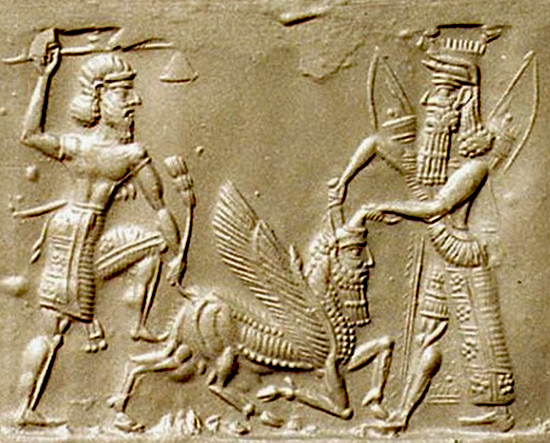
Brochures here and there tell more about the Studios, like their Hearing Voices, Seeing Visions series, which had included Gladys Swan: "Her Western epic, A Dark Gamble, was published by Serving House Books in 2015."  One Amazon reviewer called this "Gilgamesh on the western frontier" [huh.  I once wrote a poem playing with Gilgamesh.  Wonder what I did with it?].  And of course, Ken was there, former owner of Acorn Books, and Mike, a CC art teacher, and various folks I recognize in or out of coffee shops downtown.

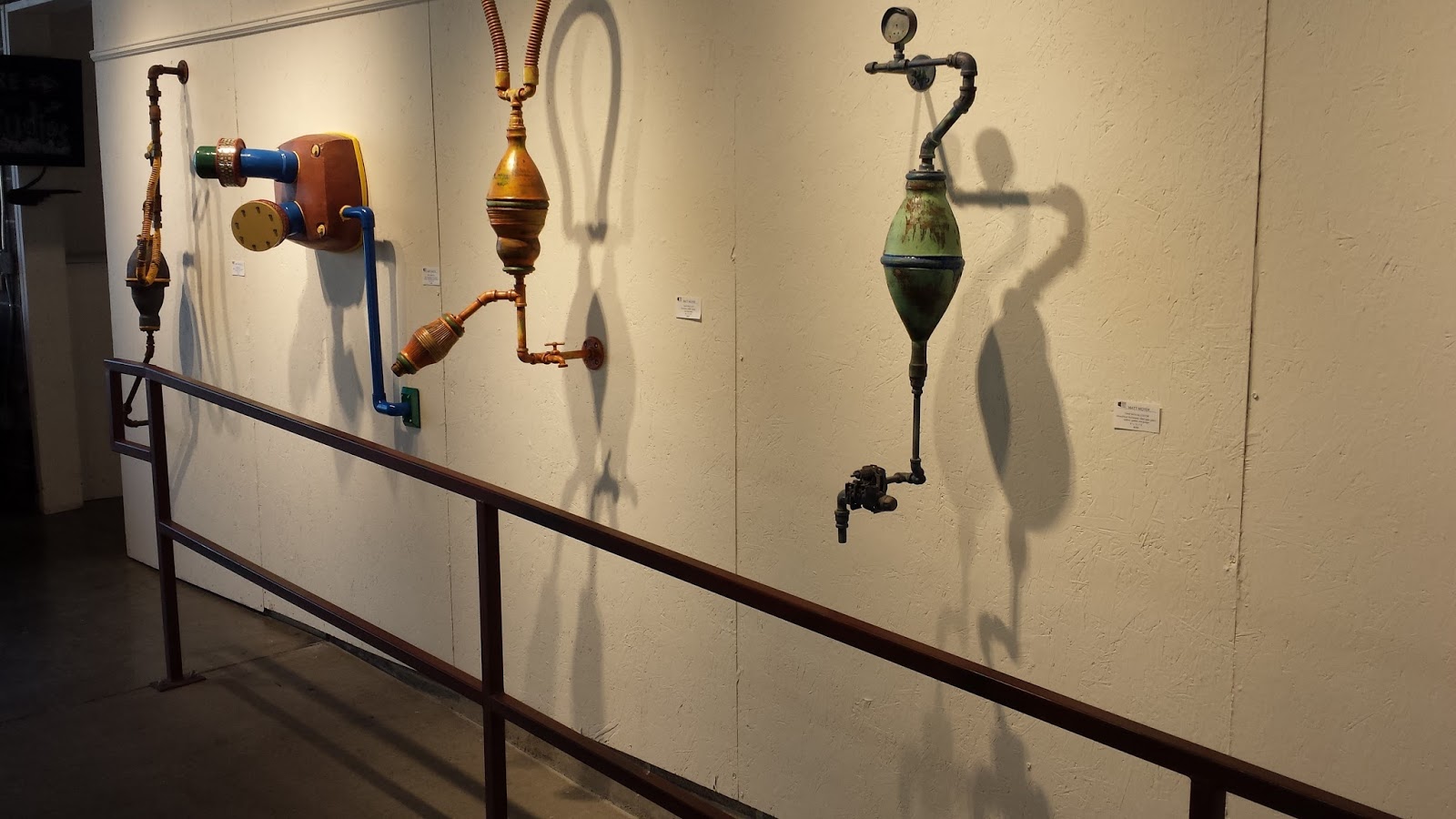
I resumed the phone-exchange with Ashton, sending some of the pump art that was on display in one hall (seems like with Ashton and Mike I spent an afternoon looking for oil can art assemblies someplace in Minnesota, as part of her steam-punk phase):


These in the 600-850$ range...(I didn't get one as a surprise holiday present.  Sorry...).

And now, out of all this?  Writing in blog form seems appropriate here, since it feeds not only off the visual, but also from the hyperlinks (no paragraph is an island unto itself--isn't that how the poem goes?) that share the immediate text with all the web, link by link, till all trace of one clod, one muddy argument, is washed away in the near-infinite sea.  And suddenly, we seem ripe for Latour, his flat ontology, his networks that link one to another to another--a great way to define human community.  Useful, yes, if one wants to diagram community, or knowledge systems, or knowledge production, in all their messy, non-linear, hypertext glories. Of course, such maps (always remember that this too is metaphor) would need to include the nuance of relative strengths in the links, the basic asymmetries of all relations--what love, friendship, hatred, disdain, is ever the same from different faces? 

Yet too much such links let us pretend that the nodes between the links are separate, are, at least from one view, closed entities, "black boxes"? (Unfair to the later Latour, who goes past his own early ANT, especially in his An Inquiry into the Modes of Existence).  For the black boxes have to themselves become "fuzzy," become ontologically unstable.

[Uh-oh, you begin to suspect...
 ]

But let me try this out--instead of network, let's think "contact zone," which, after all, is in the title, way, way up to the top.  Ok, contact zone is this messy place where everything blurs, where all the borders get fuzzy, borders like dog/human, kid/adult, expert/local, me/you, me/not-me.  Even borders like flesh-machine, which is Donna Haraway's cyborg--or me glued to my cell phone with Ashton, or our sculptor Chris who "thinks" and "feels" through the bronze and the blow-torch.  And this way of seeing things escorts us right into a different sort of reality (which in academic-speak I should label ontology).  

Here's my inspiration and source for these notions--certainly Haraway again in When Species Meet, in which she talks about "contact zone," as particular, not abstract, as "historically located, multispecies, subject-shaping encounter...fraught with power, knowledge and technique, moral questions" (205).  She goes on to cite Mary Pratt's notion that "A 'contact' perspective emphasizes how subjects are constituted in and by their relations to each other....It treats the relations ...in terms of co-presence, interaction, interlocking understandings and practices, often within radically asymmetrical relations of power" (216).  Great stuff.

                                    
(When Species Meet, lecture excerpt, 2 min)

It doesn't seem all that useful to go into some retro-Marxist view of privilege and class, nor to simply assert that we might identify network or community, but more to consider the way that art, people, plants, buildings, ideas, entertainments, and even, very much so, technology, shape this afternoon's reality, this 'mode of being.'  There, were the stakes in the pit all that sharp?


How interesting things become, when reality itself becomes plural.

later, bob